
Guide · Reporting
Management accounts vs statutory financial statements
Statutory statements are prepared for filing, lenders and auditors under a reporting framework. Management accounts are built for running the business. Most companies need both — and they should never disagree on the numbers that matter.
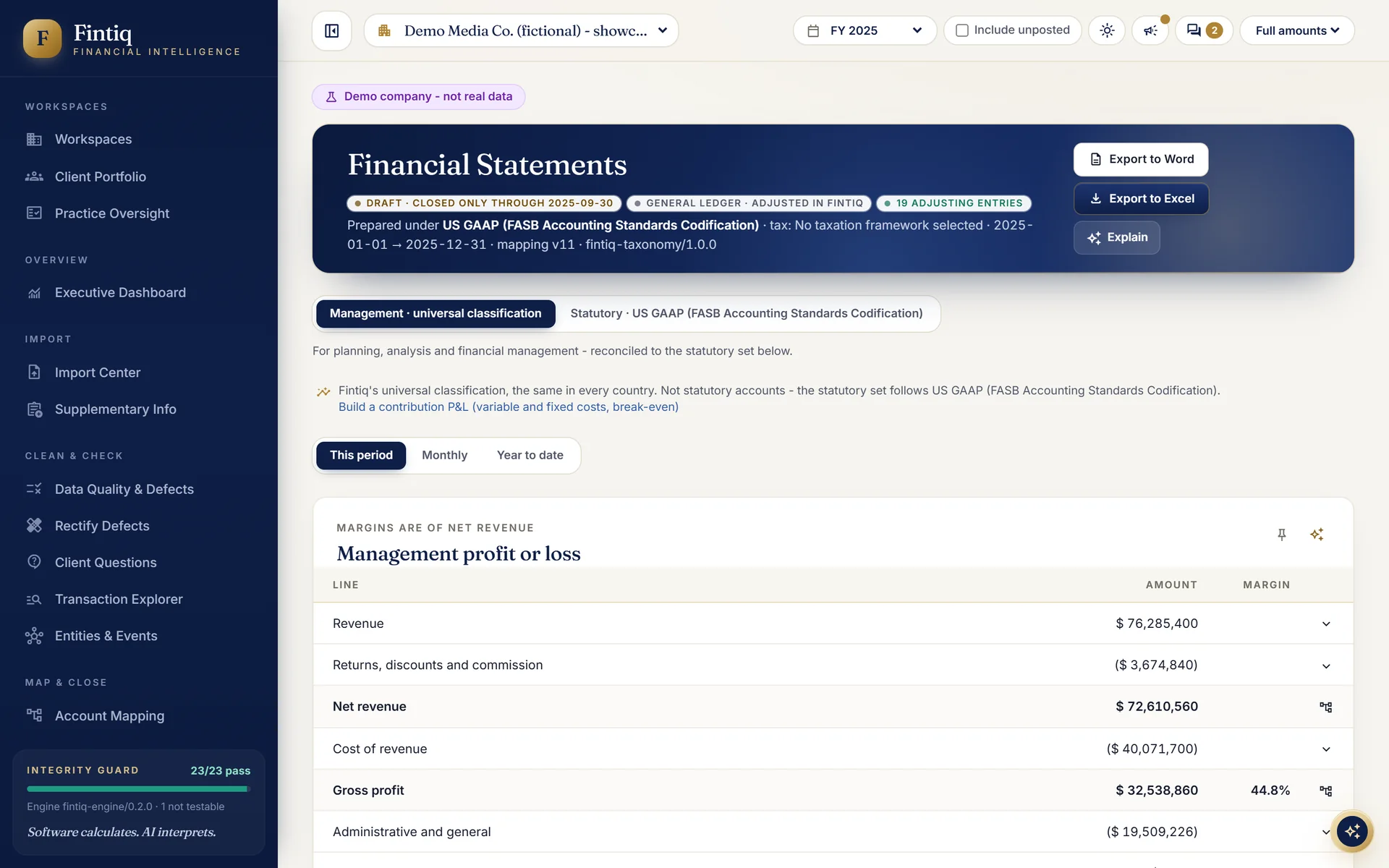
Statutory financial statements
Prepared under a financial reporting framework — US GAAP in the United States, IFRS in many other countries, or a local framework. They follow prescribed presentation (balance sheet, income statement, statement of changes in equity, cash flow statement) and come with notes and disclosures. They are what auditors audit, lenders read and regulators receive. Their captions and groupings are set by the framework, not by how the business is managed.
Management accounts
Built for decisions. They group costs the way the business is run — cost of revenue, selling, administration, depreciation — show EBITDA and EBIT with margins, present capital employed and net debt, and compare against budget and last year. They are produced monthly or weekly, and nobody files them.
The key differences
| Purpose | Statutory: compliance, filing, audit · Management: running the business |
|---|---|
| Rules | Statutory: the reporting framework · Management: whatever helps decisions |
| Frequency | Statutory: annual (sometimes quarterly) · Management: monthly or more |
| Presentation | Statutory: prescribed captions and notes · Management: EBITDA, margins, capital employed, net debt, budget comparisons |
| Netting | Statutory: some items offset or reclassified for presentation · Management: every account in its natural group |
Why they must reconcile
Both sets come from the same ledger and trial balance, so profit and net assets must agree between them. Where a statutory line differs from the management grouping — an overdrawn bank account shown as a liability, a customer in credit shown as a payable — the reconciliation should list the accounts moved and why. A business that keeps two disconnected sets of numbers will, sooner or later, decide on the wrong one.
How Fintiq does it
Fintiq produces both sets from one engine and one ledger. It opens on the management statements — all analysis runs on them — with the statutory set, under US GAAP, IFRS or a local framework, one click away. Profit and net assets are reconciled between the two, statutory lines that differ from their groups are listed with the accounts moved, and management exports are marked “not for filing”. Statutory statements come with notes, a disclosure checklist and reviewer sign-off, and are audit-grade — prepared to be audited. What is Fintiq?