
How Fintiq compares
One platform where most teams stitch together three.
Finance teams usually combine a reporting app, a planning tool and spreadsheets — and still build valuations and investment cases by hand. Fintiq does the statements, the analysis, the forecasts and the decisions on the same verified figures.
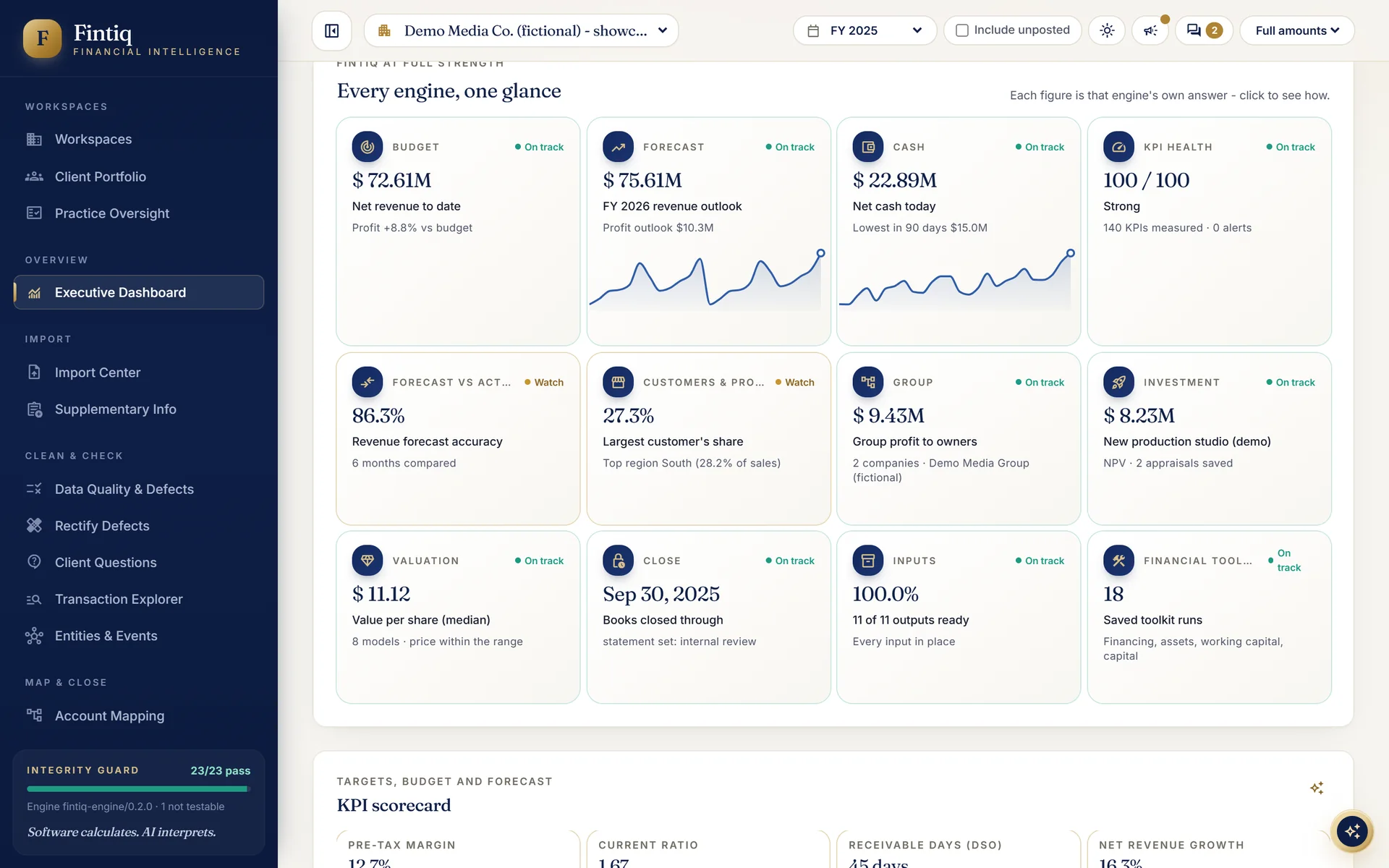
Fintiq against the usual alternatives
The comparison below is by category, not by vendor: tools within each category differ, and their features and prices change. It shows what each kind of tool is built to do.
| Capability | Fintiq | Dashboard & reporting apps | Enterprise FP&A suites | Spreadsheets + Power BI |
|---|---|---|---|---|
| Statutory financial statements with notes (US GAAP, IFRS, local) | Built in | Rarely | Rarely | Built by hand |
| Management statements and KPI dashboards | Built in, customizable | Core strength | Yes | Built by hand |
| Every figure traced to its source ledger row | Yes | Partly | Partly | Only if you build it |
| Flux and variance to customer, supplier and driver | Yes | Partly | Yes | Built by hand |
| Backtested forecasts, three-statement forecast, scenarios | Yes | Basic forecasting | Core strength | Built by hand |
| Business and share valuation (8 models) | Yes | Rarely | Rarely | Built by hand |
| Investment appraisal with tax, inflation and Monte Carlo | Yes | No | Sometimes | Built by hand |
| Financial toolkit (WACC, lease vs buy, EOQ, EVA … 18 tools) | Yes | No | No | Built by hand |
| Consolidation with eliminations and NCI | Yes | Some | Yes | Built by hand |
| Inventory valuation and job costing | Yes | No | Rarely | Built by hand |
| Ask for any report in plain words | Talk to me | Varies | Varies | No |
| Time to first statements | Same day | Same day | Weeks to months | Depends on the builder |
| Specialist skills needed | None | Low | FP&A / implementation team | Modeling, Power BI, data skills |
| Typical price | From $100 a month | Tens to hundreds of dollars a month | Often tens of thousands of dollars a year | Licenses plus the builder’s time |
“Typical price” for other categories is a broad range from publicly listed and third-party published prices; check each vendor for current terms.
Often compared with
People looking at Fintiq often also look at reporting and dashboard apps such as Fathom, Syft, Reach Reporting and Spotlight Reporting, and at FP&A platforms such as Jirav, Datarails, Cube and LiveFlow. Those tools are good at what they are built for. Fintiq is built to cover the whole path in one place — from the ledger to audit-grade statements, analysis, forecasts, valuation and investment decisions — at a price a single business can afford.
When Fintiq is the right choice
- You need statements and analysis together — not a dashboard on top of statements someone else prepares.
- You make investment, valuation or financing decisions and want them worked from your own books.
- You have no FP&A team or modeling specialist and want CFO-level outputs without building them.
- You are an accounting firm preparing statements, packs and advisory for many clients.
When something else may suit better
- You only need a monthly KPI dashboard and nothing more — a lighter dashboard app may be enough.
- You run a large enterprise planning process with hundreds of planners and custom workflows — an enterprise FP&A suite is built for that scale (talk to us about Fintiq Enterprise first).
Questions
Is Fintiq an alternative to Fathom or Syft?
For reporting and KPI dashboards, yes — and Fintiq adds statutory statements with notes, valuation, investment appraisal, a financial toolkit, consolidation and inventory in the same platform.
Is Fintiq an alternative to Datarails, Cube or Jirav?
For small and mid-sized businesses and accounting firms, yes: budgeting, forecasting, scenarios and variance analysis are built in, with no implementation project, from $100 a month.
Can Fintiq replace my spreadsheets and Power BI reports?
For financial reporting, analysis, forecasting and decision models, yes — the models are already built and tied to your ledger. Every report also exports to Excel.