
Guide · Valuation
How to value a small business from its own figures
No single number is “the” value of a business. A sound valuation runs several methods on the company’s own statements and forecast, then looks at where they agree — a range, not a promise.
Two families of methods
Intrinsic methods value the business on its own assets, earnings, dividends or cash flows. Market methods value it by comparison with what similar companies or transactions are worth. Using both, and seeing where they meet, is more reliable than trusting any one.
Intrinsic methods
- Book value per share — closing equity divided by shares in issue. A floor for asset-heavy businesses; usually too low for profitable service businesses.
- Earnings capitalized — maintainable earnings per share divided by the cost of equity. Simple and useful for stable, mature businesses.
- Gordon growth (dividend discount) — next year’s dividend divided by (cost of equity minus a long-term growth rate). Only meaningful when dividends are paid and growth is steady and below the cost of equity.
- Two-stage dividend discount — a period of higher growth, then a lower long-term rate. Better for businesses still growing quickly.
- Discounted cash flow (DCF) — free cash flows from a forecast, discounted at the weighted average cost of capital (WACC), plus a terminal value. The most complete method, and the most sensitive to its assumptions.
Market methods
- P/E multiple — earnings per share times a price-earnings ratio from comparable companies.
- EV / revenue multiple — enterprise value as a multiple of sales; common for young or low-margin businesses.
- EV / EBITDA multiple — enterprise value as a multiple of EBITDA, then net debt deducted to reach equity value.
Multiples must come from genuinely comparable companies or transactions — a valuation is only as good as the comparables behind it.
The inputs that matter most
- Cost of equity — your required return, or from CAPM (risk-free rate plus beta times the equity risk premium).
- WACC — cost of equity and after-tax cost of debt, weighted at book or market values.
- Growth — long-term growth should not exceed the long-run growth of the economy.
- Normalized earnings — remove one-offs and owner-specific costs before applying any method.
Reading the result
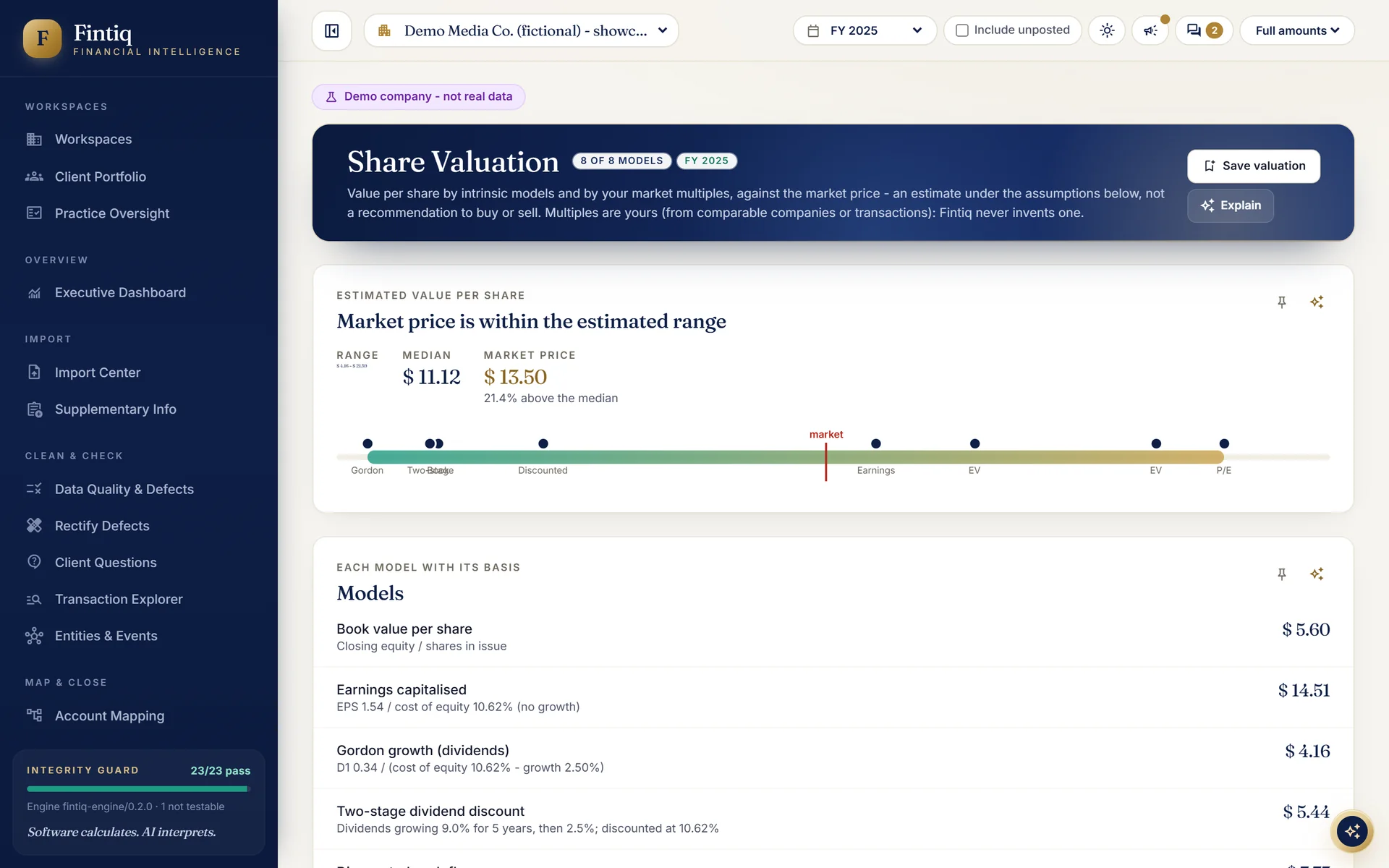
Lay the methods side by side. If they cluster, the range is credible; if one is far out, check its inputs before discarding it. Compare the range with any offer or market price: above, within or below. A valuation from your own books is an estimate for planning and negotiation — for tax, legal or court purposes, use a qualified valuer.
How Fintiq does it
Fintiq runs all eight models — book value, earnings capitalized, Gordon growth, two-stage dividend discount, DCF from its integrated forecast, and P/E, EV/revenue and EV/EBITDA multiples that you supply — on your own statements. Cost of equity comes from your rate or CAPM and WACC at book or market weights; every assumption is shown beside the result, a model that cannot run says which input it needs, and the range is shown against the market price. Fintiq never invents multiples. Valuation & decisions